
Name
Email
Subject
Message
Image (case-sensitive)

Ask a "?"

Friday, November 26, 2010

Leveraging Stress for Success

So there I was - in the middle of the cubicle farm on the 2nd floor of the Tanner, a smile on my face as I explored the wild Canadian Rocky Mountains. I was doing a Google-Earth flyover of a remote section, trying to find a way to access a new river that appeared to be full of massive trout. Just then a classmate passed by and asked, “I take it you’ve finished the HR Mid-term?” “Unfortunately not!” I replied, “I’m just looking for one more good idea and then I’m basically done.” With a hint of suspicion in his eyes, he wished me luck and moved on. The take-home midterm was due in an hour, and contrary to my friend’s skepticism, I was right on schedule. Just then an idea came to me, and I pulled everything together and turned in the test.


Stress is an inevitable piece of the MBA experience. It is considered an intrinsic part of life and a critical element of success. Without stress in our life we would likely never perform to our fullest. However, the risks of burnout are real. In a recent study performed by The National Institute for Occupational Safety and Health (NIOSH) it was discovered that 40% of all workers today feel overworked, pressured, and exerted to the point of anxiety, depression, and even disease. The American Institute of stress reports that 60% of doctor visits stem from stress-related issues. American businesses lose over $300 Billion annually to absenteeism and lowered productivity that is a direct result of bad stress.


When is stress good, and when is it bad? When we experience stress or pressure to perform, our productivity begins to increase. If we are exposed to the stress for extended periods of time, the brain releases chemicals epinephrine, norepinephrine and cortisol. These chemicals cause rises in blood pressure, heart rate, and brain activity that are injurious over time. If we continue our exposure to the stress or pressure, we experience a productivity crash (see illustration of Yerkes-Dodson curve). There is a scientifically proven technique that leverages the benefits of a complex physiological dance between stress and relaxation. Completely letting go of a stressful problem or situation for a time allows the brain to rearrange itself, so that the hemispheres can communicate better. You essentially pull the rug out from under the stressful process and allow the brain to recalibrate, thus maintaining your productivity in the optimal range and preventing it from spiraling out of control. The brain is then significantly more effective at thinking strategically and identifying creative solutions to the problem at hand.
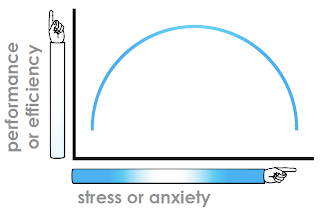


I learned this technique back in 2005 and I have noticed a significant difference in my ability to maintain sound analytical and creativity skills when pressure is high and the work is rigorous. I’ve applied this method in various settings such as high stakes meetings with executives striving for critical answers for the direction of the company, or even simply studying for the GMAT. BYU football coach Bronco Mendenhall also incorporates this technique into strategy meetings with his staff. Whenever the stakes are high and the task is laborious, we must understand the physiological effects of stress upon our brain and our ability to think creatively and holistically. The next time you feel your productivity starting to suffer, take a mental break that allows your mind to completely shift to a relaxation state, whatever that may be for you. If you feel your study group hitting the same plateau, suggest a 10-minute break that allows everyone’s minds to re-group. You will return with the benefits of more creative and clear thoughts that will consistently facilitate better decisions.


-Mike McInelly, OB/HR, Class of 2012


Monday, November 15, 2010

Using the "Force" of the OBSA

Not so long ago, and not so far away there was a techie gone HR, a.k.a. me. I was a career-changing madman trying to land an internship then, and now, a full-time career in the vast and broad field of Human Resources. I began the MBA experience knowing that the ambiguous, the challenging and dare I say mystic world of HR and Organizational Behavior was for me, but I had no clue as to HOW to turn that into reality. The answer came in the form of a student organization, the Organizational Behavior Student Association (OBSA).


The reader needs to know a little bit about the author to fully appreciate the magnitude of the change. I worked for over 8 years in technology, and at the end of that career was exposed to some advanced org design issues that transitioned my interest from the binary to the strategic. I quit work and began the school year full of optimism and hope, sure that despite the drastic shift in career fields I would quickly find success (this is where the evil Sith Lord laughs).


The OBSA provided support on all fronts: networking, resumes, interviewing, and more (for only $19.99 plus shipping and handling – payable to George Lucas). Armed with positive criticisms and feedback, I took to the job search like a techie at a Star Wars convention. Informational interviews, networking, resume submissions, but in the case of this wayward “Jedi,” the chance to interview never materialized.


As I watched my fellow classmates interview and enjoy fly backs, I felt as if I had not only failed to “use the force,” but had been encased in an “occupational carbonite block,” eat your heart out Han Solo. So I put on a brave face and tried to commiserate with my peers as they shared stories about how hard their interviews were, or how frustrating their fly backs had been, and rejoice in their individual successes. As December began, and I felt like I didn’t even have an Obi-Wan Kanobi for an only hope, the OBSA stepped in a had a few second years speak to us at a ProSem. These particular second years had found their internships late the year before. Their words of encouragement, sympathy and faith were exactly what this “Padawan learner” needed.


Because they took the time to share their emotional, difficult and sometime miraculous stories, I found the courage to keep searching for any chance I could find. My family made it a matter of much fasting and prayer and in the end I found my internship through a connection in the OBSA. As the school year rapidly neared its end, a member of the OBSA presidency reached out to me about an opportunity a connection of hers had in her organization. This company (in the fortune 50) was looking for an HR intern with a technical background, you don’t need to hear the voice say, “Use the force!” to realize that this was the perfect opportunity.


To summarize this epic story, the OBSA is focused on training and preparing the students in the HR track to be successful in the job hunt and in their future careers. This it does extremely well, however, the most valuable asset that this organization has provided me is a network of dependable, successful, and supportive friends. It has helped me build lasting relationships that will be a treasure to me both professionally and personally.


Josh Kruse, OB/HR, Class of 2011
Interned at: Northrop Grumman


Sunday, November 7, 2010

My BYU Family

Here I am, less than 6 months away from graduation, and I can proudly say that choosing BYU MBA program was the best decision I could have made 15 months ago. My decision to attend BYU raised many questions among my family and friends. Their concerns were multifaceted, but they all revolved around one question: Why would you attend BYU when you are not LDS? There were concerns about the religious and cultural differences, my ability to fit in, to form friendships and ultimately to integrate into the BYU family.


While I did not have an answer to this question 15 months ago, I had faith. Today, in looking back at what has been one of the most challenging, yet the most successful years of my life, I can say that the BYU family is behind my success story.


1. I had help. I was given all the tools necessary to succeed. The staff, professors and classmates cared about my success and provided me with the support to perform at my best. In countless occasions, students offered, unsolicited, to help me with my resumes, interviews, assignments, etc.


2. I had inspiration. I was surrounded by hard-working men and women, who were both my competition and my daily inspiration. I was inspired by the drive and determination of my classmates, who, for the most part, not only juggled schoolwork and internship search but also family responsibilities.


3. I had faith. While BYU is an LDS institution, it is an institution where anyone can freely live his or her faith. I have been able to live my religion and share my culture with very accepting colleagues. Religion has not been a differentiator but rather a way of bridging differences, learning from each other and growing as an individual.


The fact of the matter is that while the religious and cultural differences were initially a concern of mine, those differences fueled deep conversations and dialogues, which drove my integration into the BYU family.


-Thamina Sbai, Marketing, Class of 2011

Interned at: L'Oreal USA


Friday, October 29, 2010

Squeezing 29 Hours Out of Your Day

They say that the first thing Peter Drucker told executives to do was record how they spent their time throughout each day and evaluate their priorities. Of course, they also say that Peter Drucker is dead. Regardless, I decided to take on the “Drucker Challenge” for myself. I recently spent seven days carrying a little notebook around to record how I spent every minute of each day. I even recorded trivial things such as: “Watched teammates play Worms while waiting to start our meeting – 20 minutes,” or “Talked to Mac about why Supply Chain is better than OB/HR – 5 minutes.” You get the idea.


My purpose was three fold:

  1. I was feeling pretty spread thin with all my commitments and I wanted to see where I could eliminate waste (or “Mudah” as us GSCMA’ers affectionately refer to it) in my schedule.
  2. I was curious how my actions during each day matched a written list of priorities that I had.
  3. I wanted to have tangible proof of how weird I am.

I’m happy to say that this was a fruitful exercise in achieving each of my purposes.


I divided my schedule into four compartments: School, Spiritual, Career Development, and Personal (non-sleeping). Then I plugged each daily activity into one of those compartments. After the week was over I put all my data into an Excel spreadsheet and analyzed the results.


Here’s what I found:

  • All school related activities for the week only took 45 hours. I really thought this number would be closer to 70!
  • I’m really good at thinking about getting a job. I mean, I can spend hours and hours just thinking. Unfortunately, I only spent 1 hour during the week actually doing something about it (i.e. working on my resume, networking, or applying for jobs).
  • I had 40 hours of personal time to spend during the week. My funniest time log? “Legal Obligations – 1 hr 40 mins,” (good old traffic school).
  • My “Playing-Halo-with-roommates-to-going-on-dates” ratio was a solid two hours and thirty-five minutes to zero. My ecclesiastical leader may cringe at this statistic, but I’m okay with it.
  • I found multitasking to be a great way to achieve a couple priorities in my schedule at the same time (and I’m not just talking about applying for jobs while sitting in class). For example, following the news is important to me but I’ll neglect it when I’m really busy, so I make it a priority to listen to some good podcasts while I’m getting ready in the morning, commuting, cleaning, or performing any other essential task that doesn’t require a lot of thought.
  • I need to use the Internet with a purpose. Part of my study time involved going through my web browser’s viewing history and recording where I spent my online time. It was amazing how often I started out with a simple check up on my Facebook account and that somehow led to browsing Jon Hamm’s filmography on IMDB, any national articles praising Austin Collie’s brilliance, or Jim Gaffigan YouTube clips.

I have to admit that logging all my time day after day made me feel somewhat like a robot, and at times really sucked the life out of life. Having said that, I’m glad I did it and I suppose it’s an exercise I’ll repeat in the future. We all will die someday. Peter Drucker has already died. But, while we’re alive, it’s useful to periodically check how the time we spend matches the supposed priorities that we have. And, who knows? Maybe after your own careful time management review you just might realize that you can squeeze 29 hours out of your day.


-Luke Terry, Supply Chain, 2011

Interned at: SearchSino in Xi'an, China


Sunday, October 24, 2010

My OB/HR Baptism

One moment I was sitting blissfully on my orange raft, and the next, I was submerged in shark-infested (probably) white water rapids. It is difficult to describe the experience of being dislodged while white water rafting. The effects are sudden, wet, shocking, and yet, somehow satisfying (at least in the retelling). The OB/HR raft trip represented a form of baptism for me, not just in the Payette River, but also into the world of OB/HR at BYU. In fact, I would like to rechristen this event: Scout Camp meets Gourmet Road Show meets OB/HR. Certainly there were moments of pressure, and perhaps shock (Re: portapotty? Anyone???). A first-year student summed up our first evening with the recruiters: “I feel like I’m on the Bachelorette, vying for face-time.” At first, meeting the recruiters encouraged a small frenzy, but after the first night, the pressure dissipated and we had FUN. We hung out. And, frankly, the most useful information was not facts about the companies, but rather the more subtle and personal details about the individuals.


My favorite conversations were the casual, inane, and downright ridiculous. I would like to record some of those here. (Names have been deleted to protect the innocent):


  1. “Our group last year was all the jocks.” Ten minutes later. “I’m a dancer. And I love flower gardening.”
  2. “I heart HR [insert 5 minutes of new and strange HR jargon] I heart HR”
  3. “People always call me Ryan when they forget my name. Then I found out that my mother was planning to name me Ryan all along! But my aunt used it for her kid right before I was born and my mom couldn’t use it, so actually my name SHOULD be Ryan. Isn’t that weird?”
  4. “I love my Harley. Maybe not the best investment...but my Harley makes me so happy.”
  5. “Guys, we totally have to have a strategy for attacking that other raft.”
  6. “In Russia you can’t throw the garbage away until your guest is safely home, or it’s bad luck.”
  7. “My wife is such a good mom. I just got lucky” What a softy. Later: “I am going to attack you tomorrow.” (FYI: he is a man of his word.)
  8. (upon viewing natural Idaho scenery): “You guys have really done a great job with the landscaping here. I mean, it must have taken forever to haul in all these trees.”
  9. “I have never [fill in blank with whatever you want]”
  10. (Singing Aboard Raft à la Titanic): “Sempre libera degg´io folleggiare di gioia in gioia!!!!!”
  11. “I have never rooted for BYU...I have never rooted for BYU...define root”


Other significant moments: I showed up without proper gear, but was speedily provided with a sleeping bag, sleeping mat, and flashlight! I am now a firm supporter of Boy Scouts of America, even if they plan vacations without washrooms. Another was a classmate saving me a coveted seat by the fire, knowing how important it was to my survival. These conversation snippets and anecdotes may seem silly and meaningless. But, to me, these are the crucial conversations. There is everything to be learned from small talk. With each exchange, I form my perception of the other person, reflect it back on myself, and begin to shape my professional identity. Unarticulated questions are a running backdrop: Am I like you? Do I like being with you? Could I become like you? Do I want to? Every conversation was a window into OB/HR, and into my future.


While I would like to say that I came out of the OB/HR Rafting Trip with a clear sense of direction (track, company, position, salary, location) - I didn’t. I emerged drenched in questions. What I did come out with was a tangible knowledge that I really like these people. In fact, I like them a lot. And since a church can be judged by its members, I must say that my recent baptism into OB/HR may shortly become a conversion.


Elizabeth Keeler, OB/HR, Class of 2012