Name
Email
Subject
Message
Image (case-sensitive)

Ask a "?"

Friday, December 31, 2010

What Executives Are Saying

As you enter the Tanner Building (the building the business school is located in), you see these beautiful gigantic blue banners that have several quotes of top executives describing the business students. We wanted to share some of those quotes with you:


"You will not find a better group of graduates than those educated and trained at the Marriott School of Management.... Their second-language capability and international experience are unequaled by any other business school."

— Nolan Archibald
Executive Chairman, Stanley Black & Decker


"BYU students are trailblazers. They approach problems with open minds and are eager to find creative solutions. I'm impressed with their dedication to innovation."

— Fraser Bullock
Founder/Managing Director, Sorenson Capital


"Graduates come away from the Marriott School with a very high ethical standard. You don't have to worry about what's underneath the résumé."

— Frank Crespo
Vice President and Chief Procurement Officer, Caterpillar Inc.


"One thing that differentiates the Marriott School is the experience of the student body.... Since business is conducted in a global framework, hiring people who have had real life experience in a variety of countries with a variety of languages allows for a more effective, deeper relationship with the clients."

— Linda Daines
Managing Director, Goldman Sachs


"The school offers mature individuals. Most graduates come out of school with an understanding of what it takes to work hard. They are very strong when it comes to figuring out and solving problems. They are ready to make a contribution."

— Reed Maughan
Partner, PricewaterhouseCoopers LLP


"From my experience, communication and analytical skills are the strongest differentiators between students at BYU and those at other universities. Students take multiple classes that develop and hone these talents, which make BYU grads valuable employees."

— Eric Varvel
CEO, Credit Suisse Investment Bank


Source: https://marriottschool.byu.edu/recruiter/index/executivessay


Tuesday, December 21, 2010

Interview with Jan Saumweber

Jan Saumweber, SVP of Sara Lee’s Global Walmart Team, gives advice on anticipating how your chosen role (e.g. sales vs marketing) will affect your family, recounts how showing strong ethics early in her career gained her credibility, and finally encourages women to join the business community. Enjoy!


Check out more interviews at the BYU MBA Morning Market Call.

Thursday, December 16, 2010

BYU MBA Stress Management

Word on the street is that the MBA program is stressful. So we set out Mythbuster-style to find out just how stressed people are these days. We found that the vast majority of BYU MBAs (70%) report having medium to high stress on average, with only 3% reporting very high stress and everyone else claiming low or very low stress levels.


It’s possible our data was skewed by the likelihood that MBAs with very high stress are less likely to take non-essential surveys. Then again, that same group is equally unlikely to be reading this, hence a mutual nose-thumbing is in order.


MBAs employ a variety of methods to manage stress. Aside from the usual suspects of exercise, sleep, socializing, and “couch-potato-ing” (actually recorded in our responses), 20% of respondents reported using food (both the good and the bad kinds) to lower stress and 26% claimed to use Jedi mind tricks to counter stress. Among our favorites in the ‘other’ category are: calling my mom, praying often, eliminating cause (we’re interested to know how), getting out of Provo, and hanging out with people more stressed to see how ridiculous they are.


-Merritt Aho, Marketing, Class of 2011

Wednesday, December 1, 2010

The High-Performance Machine

When I wake up today, I’m a 31 year old MBA student-husband-father-friend-classmate with possibly overly divided attentions, a growing list of personal successes, an also growing list of mistakes and awkward ideas, and a rolling list of to-dos that just seems to exist no matter how much effort I put into eliminating it. I’m ambitious. I expect myself to make a difference. I want to contribute valuable insights and work. I want the next moment to be my best moment. I hope the last less-than-my-best moment will go away quietly.


I’m thrilled with this knowledge-building, friendship-gaining, connection-finding, experience-gathering opportunity. I’m also exhausted by it. I’m enjoying this experience, and I expect I’m going to get better at it, but, in the meantime, all of these roles and goals and activities are putting a lot of miles on me.


And that got me thinking again about what I’m doing to keep me going.


A while ago I found that I had to be a lot more careful about what I ate and how much I slept in order to be clear and engaged in my work. It wasn’t that I was suddenly motivated to turn myself into some superhuman gladiator capable of conquering anything I came in contact with. These changes were to just keep up.


I assumed I was getting old, and it was now my job to make sure I didn’t fall apart.


Recently, it occurred to me that needing to eat and sleep better might have less to do with being “old” than I had thought. While looking over a sports car, it dawned on me that the high-performance vehicle required special motor oils, the highest quality fuel, and special tuning in order to function properly. If the car didn’t get those necessities, then it would actually function worse than its less than sporty commuter-class counterparts.


The light went on, and I suddenly realized (rationalized) that I wasn’t getting old, instead, after growing up as a commuter-class “me” that could deal with irregular maintenance and lower quality fuels, I had somewhere transformed into a high-performance “me” that would accept nothing less than the best to manage this high-performance lifestyle I was living.


I know I’m not the only one balancing the student, family, friend, job-hunter, success, failure, feeling-found, feeling-lost lifestyle, and I believe I’m not the only one who’s suffering from “high-performance” maintenance requirements. So, I hope all of you are also enjoying this MBA experience, and I encourage you to keep diving in where you see fit, and, if you’re feeling like this experience is making you age quickly, I suggest to you that you see it instead as refining you into a high-performance machine that needs special maintenance and care, and then continue maintaining yourself accordingly.


Christian Mealey, Marketing, Class of 2012


Friday, November 26, 2010

Leveraging Stress for Success

So there I was - in the middle of the cubicle farm on the 2nd floor of the Tanner, a smile on my face as I explored the wild Canadian Rocky Mountains. I was doing a Google-Earth flyover of a remote section, trying to find a way to access a new river that appeared to be full of massive trout. Just then a classmate passed by and asked, “I take it you’ve finished the HR Mid-term?” “Unfortunately not!” I replied, “I’m just looking for one more good idea and then I’m basically done.” With a hint of suspicion in his eyes, he wished me luck and moved on. The take-home midterm was due in an hour, and contrary to my friend’s skepticism, I was right on schedule. Just then an idea came to me, and I pulled everything together and turned in the test.


Stress is an inevitable piece of the MBA experience. It is considered an intrinsic part of life and a critical element of success. Without stress in our life we would likely never perform to our fullest. However, the risks of burnout are real. In a recent study performed by The National Institute for Occupational Safety and Health (NIOSH) it was discovered that 40% of all workers today feel overworked, pressured, and exerted to the point of anxiety, depression, and even disease. The American Institute of stress reports that 60% of doctor visits stem from stress-related issues. American businesses lose over $300 Billion annually to absenteeism and lowered productivity that is a direct result of bad stress.


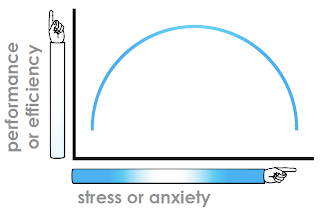
When is stress good, and when is it bad? When we experience stress or pressure to perform, our productivity begins to increase. If we are exposed to the stress for extended periods of time, the brain releases chemicals epinephrine, norepinephrine and cortisol. These chemicals cause rises in blood pressure, heart rate, and brain activity that are injurious over time. If we continue our exposure to the stress or pressure, we experience a productivity crash (see illustration of Yerkes-Dodson curve). There is a scientifically proven technique that leverages the benefits of a complex physiological dance between stress and relaxation. Completely letting go of a stressful problem or situation for a time allows the brain to rearrange itself, so that the hemispheres can communicate better. You essentially pull the rug out from under the stressful process and allow the brain to recalibrate, thus maintaining your productivity in the optimal range and preventing it from spiraling out of control. The brain is then significantly more effective at thinking strategically and identifying creative solutions to the problem at hand.


I learned this technique back in 2005 and I have noticed a significant difference in my ability to maintain sound analytical and creativity skills when pressure is high and the work is rigorous. I’ve applied this method in various settings such as high stakes meetings with executives striving for critical answers for the direction of the company, or even simply studying for the GMAT. BYU football coach Bronco Mendenhall also incorporates this technique into strategy meetings with his staff. Whenever the stakes are high and the task is laborious, we must understand the physiological effects of stress upon our brain and our ability to think creatively and holistically. The next time you feel your productivity starting to suffer, take a mental break that allows your mind to completely shift to a relaxation state, whatever that may be for you. If you feel your study group hitting the same plateau, suggest a 10-minute break that allows everyone’s minds to re-group. You will return with the benefits of more creative and clear thoughts that will consistently facilitate better decisions.


-Mike McInelly, OB/HR, Class of 2012