Name
Email
Subject
Message
Image (case-sensitive)

Ask a "?"

Showing posts with label Succeeding in Business School. Show all posts

Thursday, January 6, 2011

SHERPA Advice

We asked the MBA Sherpa’s (2nd year MBA’s who mentor and coach 1st years through their internship search) to give some advice to the 1st years entering their second semester of business school. We thought we would share their advice with you:


The Sherpa program has been a lot of fun. I have become friends with several students that I would normally not have much contact with. You are amazing...


“Believe in yourself. Believe in your capacity to do great and good things. Believe that no mountain is so high that you cannot climb it. Believe that no storm is so great that you cannot weather it. You are not destined to be a scrub. You are a child of God, of infinite capacity. Believe that you can do it - whatever it is that you set your heart on. Opportunities will unfold and open before you. The skies will clear when they have been dark with portent.” – Gordon B. Hinckley“


If you wait till the last minute, it only takes a minute.


You’re good enough, you’re smart enough, but dog-gone it, make people like you.


Your focus needs more focus.


My Mama always said, “Life was like a box of chocolates; you never know what you‘re gonna get.”


1st or 2nd years taking the Heaton Beatin‘ next semester, do not be afraid. All you need to do to ace the class is simply ask Prof. Heaton, “You worked at BCG?“ That is sufficient for an A-.


Advice to those searching for jobs: Your future depends on your dreams, so make sure you‘re getting some sleep.


Interviewing for internships is like seeing a proctologist.... it‘s uncomfortable, it‘s awkward, you feel exposed, and when everyone asks you about it later, you‘re just glad they weren‘t there to watch.


It‘ll work out. It always does.


My Mama always said, “Stupid is as stupid does.“


Getting internships is like being water boarded...it feels like you‘re going to die and you keep asking yourself, “How can what they‘re doing to me be legal?”


It still amazes me that just because I‘m a BYU MBA I can reach out to any alumni in any company and get the inside scoop. Awesome!


Pay attention to relationships and don‘t sweat the grades.


Don‘t forget to include your family in your schoolwork and internship search.


The best advice I can give is to ask for help! There are so many people in this world that would love to tell you how unimpressive you really are and how to get better. Benjamin Franklin said, “The first degree of folly, is to conceit one‘s self wise; the second to profess it; the third to despise counsel.“



Wednesday, December 1, 2010

The High-Performance Machine

When I wake up today, I’m a 31 year old MBA student-husband-father-friend-classmate with possibly overly divided attentions, a growing list of personal successes, an also growing list of mistakes and awkward ideas, and a rolling list of to-dos that just seems to exist no matter how much effort I put into eliminating it. I’m ambitious. I expect myself to make a difference. I want to contribute valuable insights and work. I want the next moment to be my best moment. I hope the last less-than-my-best moment will go away quietly.


I’m thrilled with this knowledge-building, friendship-gaining, connection-finding, experience-gathering opportunity. I’m also exhausted by it. I’m enjoying this experience, and I expect I’m going to get better at it, but, in the meantime, all of these roles and goals and activities are putting a lot of miles on me.


And that got me thinking again about what I’m doing to keep me going.


A while ago I found that I had to be a lot more careful about what I ate and how much I slept in order to be clear and engaged in my work. It wasn’t that I was suddenly motivated to turn myself into some superhuman gladiator capable of conquering anything I came in contact with. These changes were to just keep up.


I assumed I was getting old, and it was now my job to make sure I didn’t fall apart.


Recently, it occurred to me that needing to eat and sleep better might have less to do with being “old” than I had thought. While looking over a sports car, it dawned on me that the high-performance vehicle required special motor oils, the highest quality fuel, and special tuning in order to function properly. If the car didn’t get those necessities, then it would actually function worse than its less than sporty commuter-class counterparts.


The light went on, and I suddenly realized (rationalized) that I wasn’t getting old, instead, after growing up as a commuter-class “me” that could deal with irregular maintenance and lower quality fuels, I had somewhere transformed into a high-performance “me” that would accept nothing less than the best to manage this high-performance lifestyle I was living.


I know I’m not the only one balancing the student, family, friend, job-hunter, success, failure, feeling-found, feeling-lost lifestyle, and I believe I’m not the only one who’s suffering from “high-performance” maintenance requirements. So, I hope all of you are also enjoying this MBA experience, and I encourage you to keep diving in where you see fit, and, if you’re feeling like this experience is making you age quickly, I suggest to you that you see it instead as refining you into a high-performance machine that needs special maintenance and care, and then continue maintaining yourself accordingly.


Christian Mealey, Marketing, Class of 2012


Friday, November 26, 2010

Leveraging Stress for Success

So there I was - in the middle of the cubicle farm on the 2nd floor of the Tanner, a smile on my face as I explored the wild Canadian Rocky Mountains. I was doing a Google-Earth flyover of a remote section, trying to find a way to access a new river that appeared to be full of massive trout. Just then a classmate passed by and asked, “I take it you’ve finished the HR Mid-term?” “Unfortunately not!” I replied, “I’m just looking for one more good idea and then I’m basically done.” With a hint of suspicion in his eyes, he wished me luck and moved on. The take-home midterm was due in an hour, and contrary to my friend’s skepticism, I was right on schedule. Just then an idea came to me, and I pulled everything together and turned in the test.


Stress is an inevitable piece of the MBA experience. It is considered an intrinsic part of life and a critical element of success. Without stress in our life we would likely never perform to our fullest. However, the risks of burnout are real. In a recent study performed by The National Institute for Occupational Safety and Health (NIOSH) it was discovered that 40% of all workers today feel overworked, pressured, and exerted to the point of anxiety, depression, and even disease. The American Institute of stress reports that 60% of doctor visits stem from stress-related issues. American businesses lose over $300 Billion annually to absenteeism and lowered productivity that is a direct result of bad stress.


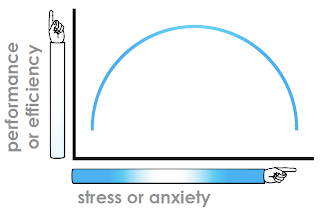
When is stress good, and when is it bad? When we experience stress or pressure to perform, our productivity begins to increase. If we are exposed to the stress for extended periods of time, the brain releases chemicals epinephrine, norepinephrine and cortisol. These chemicals cause rises in blood pressure, heart rate, and brain activity that are injurious over time. If we continue our exposure to the stress or pressure, we experience a productivity crash (see illustration of Yerkes-Dodson curve). There is a scientifically proven technique that leverages the benefits of a complex physiological dance between stress and relaxation. Completely letting go of a stressful problem or situation for a time allows the brain to rearrange itself, so that the hemispheres can communicate better. You essentially pull the rug out from under the stressful process and allow the brain to recalibrate, thus maintaining your productivity in the optimal range and preventing it from spiraling out of control. The brain is then significantly more effective at thinking strategically and identifying creative solutions to the problem at hand.


I learned this technique back in 2005 and I have noticed a significant difference in my ability to maintain sound analytical and creativity skills when pressure is high and the work is rigorous. I’ve applied this method in various settings such as high stakes meetings with executives striving for critical answers for the direction of the company, or even simply studying for the GMAT. BYU football coach Bronco Mendenhall also incorporates this technique into strategy meetings with his staff. Whenever the stakes are high and the task is laborious, we must understand the physiological effects of stress upon our brain and our ability to think creatively and holistically. The next time you feel your productivity starting to suffer, take a mental break that allows your mind to completely shift to a relaxation state, whatever that may be for you. If you feel your study group hitting the same plateau, suggest a 10-minute break that allows everyone’s minds to re-group. You will return with the benefits of more creative and clear thoughts that will consistently facilitate better decisions.


-Mike McInelly, OB/HR, Class of 2012